


Trombone players have been debating the use of slide lubricants for nearly a century. What is the best trombone slide lubricant, and how do you properly prepare and lubricate a slide? This question has sparked endless discussion in studios, rehearsal halls, and now across social media platforms. To show that this is far from a new debate, we recently uncovered a rare 1954 letter from Vincent Bach, the legendary maker of Stradivarius brass instruments, detailing his step-by-step instructions for cleaning and lubricating a trombone slide.
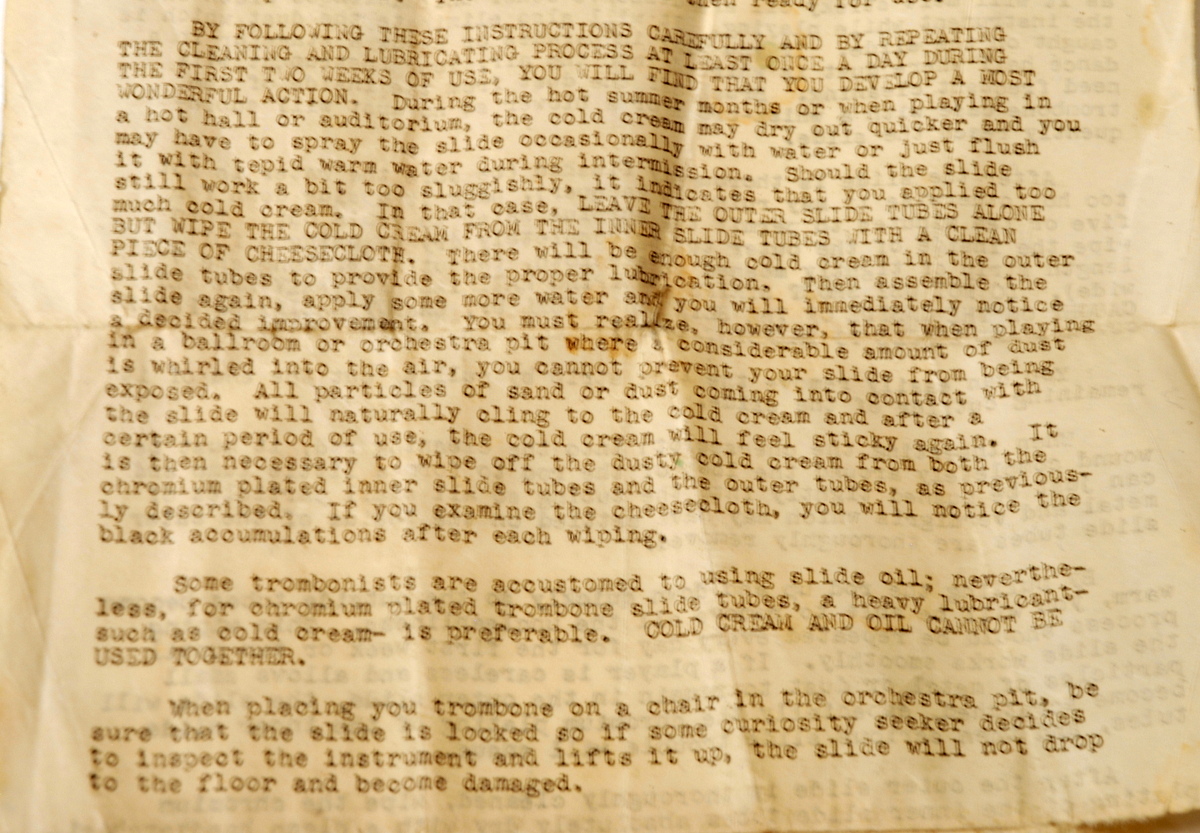
This particular letter came to light when a beautiful condition Bach 36 from the 1950s arrived at The Brass Exchange in St. Louis, Missouri. Inside its case was the original printed sheet—a remarkable piece of history that revealed Bach’s craftsmanship and his personal attention to players who chose his instruments. One of the most memorable passages is his practical stage advice for professionals: “When placing your trombone on a chair in the orchestra pit, be sure that the slide is locked, so if some curiosity seeker decides to inspect the instrument and lift it up, the slide will not fall to the floor and become damaged.”
Trombonists today still struggle with the same core issue—keeping a slide fast, smooth, and responsive. Bach’s 1954 letter highlights timeless principles of patience, careful lubrication, and proper cleaning that remain relevant. Below, we’ve preserved the original document, shown in its authentic style and grammar, along with a full transcription for modern readers.
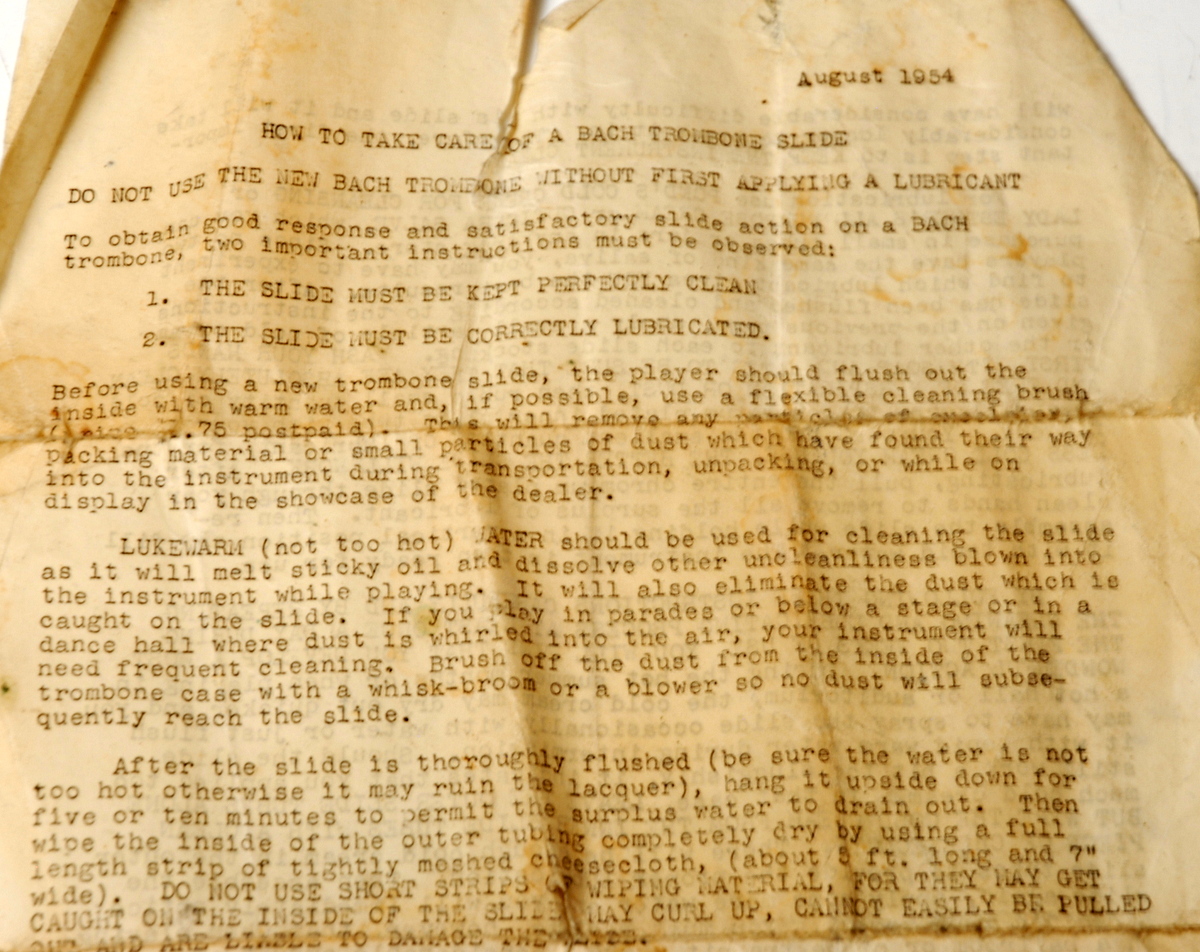
August 1954
HOW TO TAKE CARE OF A BACH TROMBONE SLIDE
DO NOT USE THE NEW BACH TROMBONE WITHOUT FIRST APPLYING A LUBRICANT
To obtain good response and satisfactory slide action on a BACH
trombone, two important instructions must be observed:
1. THE SLIDE MUST BE KEPT PERFECTLY CLEAN
2. THE SLIDE MUST BE CORRECTLY LUBRICATED.
Before using a new trombone slide, the player should flush out the
inside with warm water and, if possible, use a flexible cleaning brush.
Packing material or small particles of dust which have found their way
into the instrument during transportation, unpacking, or while on
display in the showcase of a dealer.
LUKEWARM (not too hot) WATER should be used for cleaning the slide
as it will melt sticky oil and dissolve other uncleanliness blown into
the instrument while playing. It will also eliminate the dust which is
caught on the slide. If you play in parades or below a stage or in a
dance hall where dust is whirled into the air, your instrument will
need frequent cleaning. Brush out the dust from inside of the
trombone case with a whisk-broom or a blower so no dust will subse-
quently reach the slide.
After the slide is thoroughly flushed (be sure the water is not
too hot otherwise it may ruin the lacquer), hang it upside down for
five or ten minutes to permit the surplus water to drain out. Then
wipe the inside of the outer tube completely dry by using a full
length strip of tightly moshed cheesecloth, (about 3 ft. long and 7"
wide). DO NOT USE SHORT STRIPS OF WIPING MATERIAL, FOR THEY MAY GET
CAUGHT ON THE INSIDE OF THE SLIDE AND CURL UP. CANNOT EASILY BE PULLED
OUT AND MAY DAMAGE THE SLIDE.
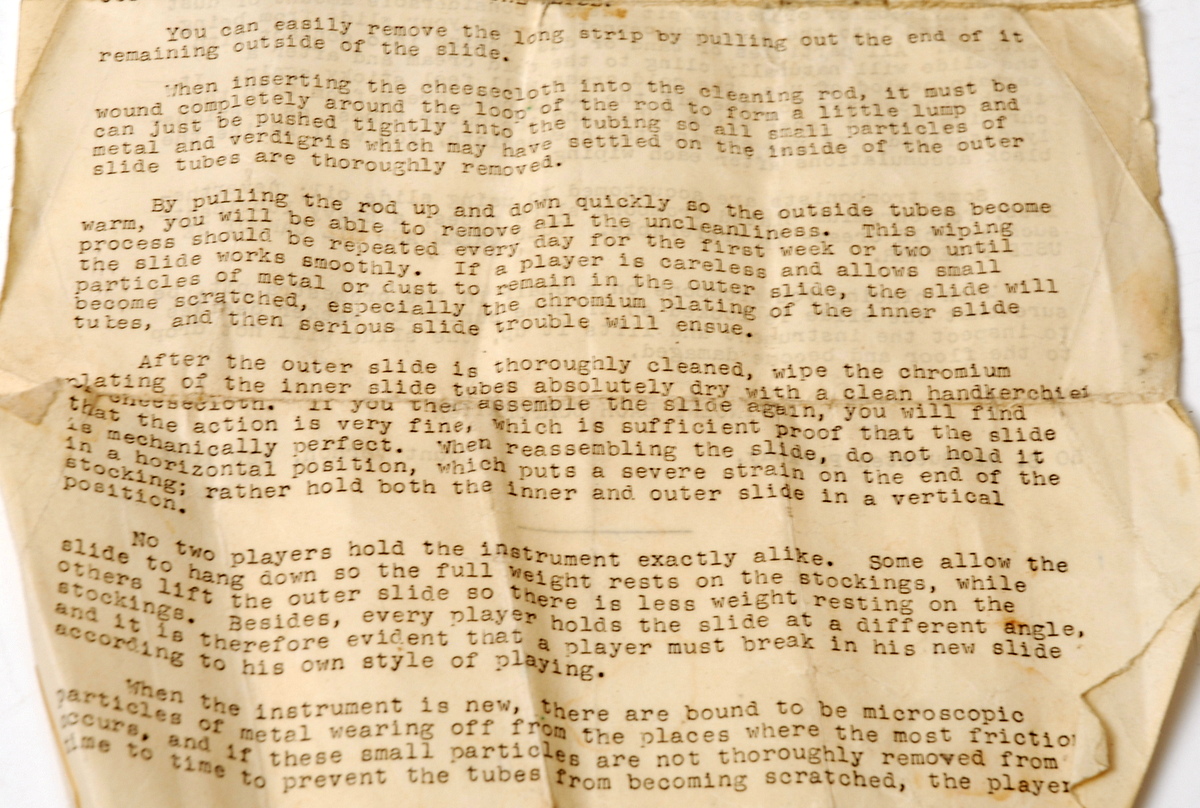
You can easily remove the long strip by pulling out the end of it
remaining outside of the slide.
When inserting the cheesecloth into the cleaning rod, it must be
wound completely around the rod without any little lump and
can just be pushed tightly into the tube so all particles of
metal and verdigris which may have settled on the inside of the outer
slide tubes are thoroughly removed.
By pulling the rod up and down quickly so the outside tubes become
warm, you will be able to remove fully all the uncleanliness. This wiping
process should be repeated every day for the first week or two until
the slide works smoothly. If a player is careless and allows small
particles of metal or dust to remain in the outer slide, the slide will
become scratched, especially the chromium plating of the inner slide
tubes, and then serious trouble will ensue.
After the outer slide is thoroughly cleaned, wipe the chromium
plating of the inner slide tubes absolutely dry with a clean handkerchief.
When assembling the slide again, you will find
that the action is very fine, which is sufficient proof that the slide
is mechanically perfect. When reassembling the slide, do not hold it
in a horizontal position, which puts a severe strain on the end of the
stocking; rather hold both the inner and outer slide in a vertical
position.
No two players hold the instrument exactly alike. Some allow the
slide to hang down so the full weight rests on the stockings, while
others lift the outer slide so there is less weight resting on the
stockings. Besides, every player holds the slide at a different angle,
and it is therefore evident that a player must break in his new slide
according to his own style of playing.
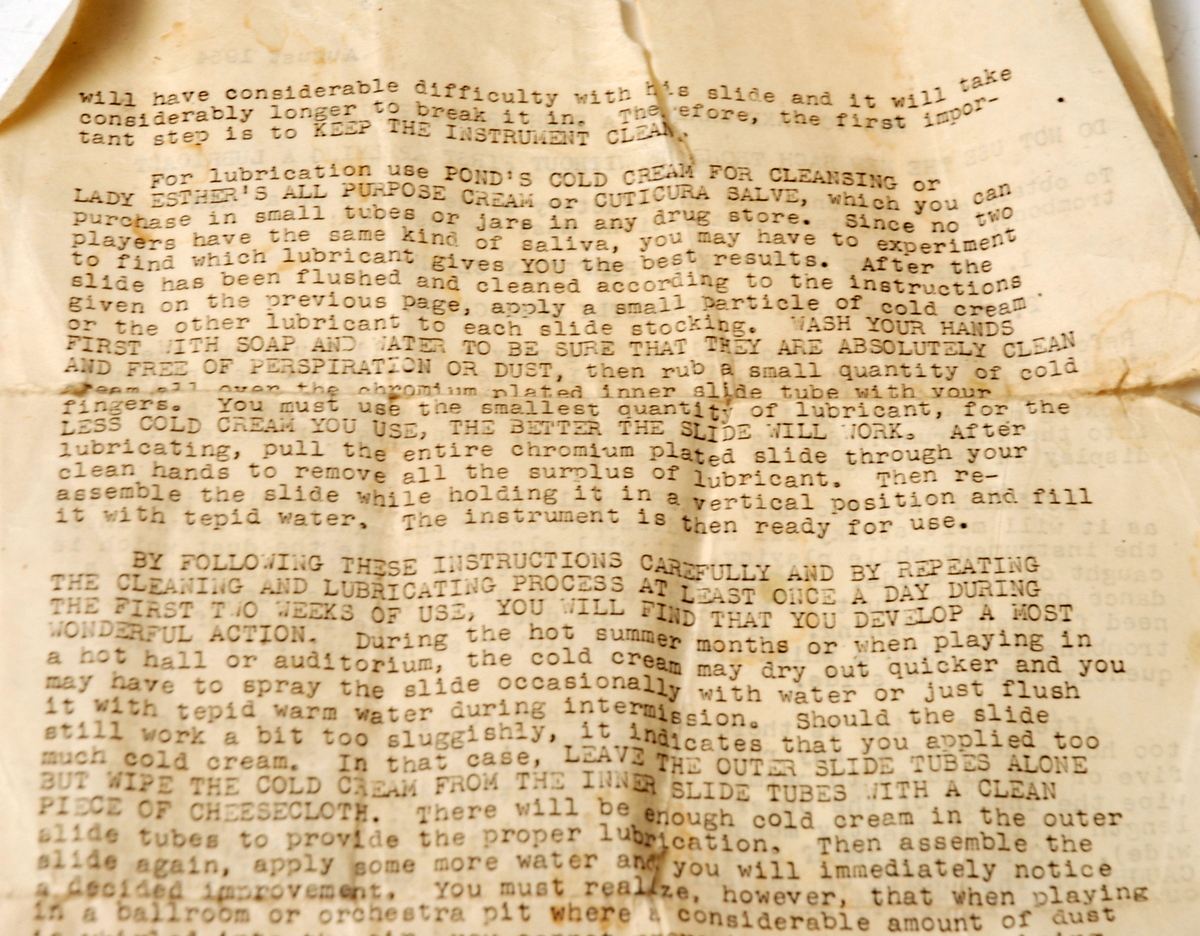
When the instrument is new, there are bound to be microscopic particles of
metal wearing off from the places where the most friction occurs, and if these
small particles are not thoroughly removed from time to time to prevent the
tubes from becoming scratched, the player will have considerable difficulty
with the slide and it will take considerably longer to break it in.
Therefore, the first important step is to KEEP THE INSTRUMENT CLEAN.
For lubrication use POND’S COLD CREAM FOR CLEANSING or LADY ESTHER’S ALL
PURPOSE CREAM or CUTICURA SALVE, which you can purchase in small tubes
or jars in any drug store. Since no two players have the same kind of saliva,
you may have to experiment to find which lubricant gives you the best results.
After the slide has been flushed and cleaned according to the instructions
given on the previous page, apply a small particle of cold cream or the other
lubricant to each slide stocking. WASH YOUR HANDS FIRST WITH SOAP AND WATER
TO BE SURE THAT THEY ARE ABSOLUTELY CLEAN AND FREE OF PERSPIRATION OR DUST,
then rub a small quantity of cold cream onto the chromium plated inner slide
tube with your fingers.
You must use the smallest quantity of lubricant, for the less cold cream you
use, the better the slide will work. After lubricating, pass the entire
chromium plated slide through your clean hands to remove all the surplus of
lubricant. Then reassemble the slide while holding it in a vertical position
and fill it with tepid water. The instrument is then ready for use.
BY FOLLOWING THESE INSTRUCTIONS CAREFULLY AND BY REPEATING THE CLEANING AND
LUBRICATING PROCESS AT LEAST ONCE A DAY DURING THE FIRST TWO WEEKS OF USE, YOU
WILL DEVELOP A MOST WONDERFUL ACTION.
During the hot summer months or when playing in a hot hall or auditorium, the
cold cream may dry out quicker and you may have to spray the slide
occasionally with water or just flush it with tepid warm water during
intermission.
Should the slide still work a bit too sluggishly, it indicates that you
applied too much cold cream. In that case, LEAVE THE OUTER SLIDE TUBES ALONE
BUT WIPE THE COLD CREAM FROM THE INNER SLIDE TUBES WITH A CLEAN PIECE OF
CHEESECLOTH. There will be enough cold cream in the outer slide tubes to
provide the proper lubrication. Then assemble the slide again, apply some more
water and you will immediately notice a decided improvement.
You must realize, however, that when playing in a ballroom or orchestra pit
where considerable amount of dust is whirled into the air, you cannot prevent
your slide from being exposed. All particles of sand or dust coming into
contact with the slide will naturally cling to the cold cream and after a
certain period of use, the cold cream will feel sticky again.
It is then necessary to wipe off the cold cream from both the chromium plated
inner slide tubes and the outer tubes, as previously described. If you examine
the cheesecloth, you will notice the black accumulations after each wiping.
As the slide tubes do not become absolutely true immediately after
manufacturing, but need some playing to be worn in perfectly, you
will find that the slide will run more freely after being used for a
while. This applies to all makes of trombones and is not peculiar
to Bach instruments only. The more careful you are in the beginning,
the better the slide will be in the end. The slide must not be forced
and if you should notice that it does not work freely after a while,
although it has been properly lubricated, it should be returned to us
for inspection. Please do not send it to other repair shops, as they
may not be properly equipped to handle Bach instruments.
We are at all times at your service should you have any questions
in connection with your instrument and its care. It is our desire
to see that you derive the utmost satisfaction from your Bach
trombone.
Very truly yours,
Vincent Bach Corp.
Vincent Bach, President
This letter from Vincent Bach is more than just a relic — it’s a reminder that trombonists have been debating and refining slide care for generations. While products and techniques have evolved, the core principle remains the same: a well-prepared slide makes for a more responsive and musical instrument.
Looking for guidance on the best trombone slide lubricant today? At The Brass Exchange, we work with players of every level and keep a full range of modern lubricants in stock. Whether you prefer a cream, a liquid, or a hybrid formula, we can help you find the setup that matches your horn and your style. 👉 Browse our current trombone inventory here.